
Flappy Bird Casino Game Strategies:
How to Win in 2026
Expert bankroll management frameworks, RTP mathematics, and the dual-bet hedge strategy for Flappy Rise by Astriona — tested across 500+ sessions by Aaron Mitchell, iGaming analyst.
Use this strategy page as a planning tool rather than a promise of results. Start by separating what the rules guarantee from what only changes your risk profile: stake size, cash-out target, session length, bonus terms and the pace of play. That distinction matters because a lower target or slower session can make decisions easier, but it does not remove the house edge or make a volatile round safe.
A practical strategy should feel repeatable under pressure. Before real play, test one idea in demo, keep the same stake for a short run, and notice where you feel tempted to break the plan. If a bonus is involved, check wagering terms before you adjust bet size or session length.
With that routine, the page becomes a calm checklist: clear limits, patient pacing, and fewer impulsive choices. The aim is not to outsmart randomness; it is to keep the session readable enough that you can stop on time.
Practical strategy notes
Before you play Flappy Rise, use this page to slow the session down. Look first at dual betting, auto cash out and crash-style bankroll control. These are the parts of the game that usually make a balance move faster, so choose your stake and stop point before the first round or spin. A small plan is easier to follow than a complicated system, especially after a quick win or a frustrating loss.
A useful warm-up is simple: test the safer first panel separately from the higher-target second panel. Keep the same stake during the test, then write down the starting balance, ending balance and whether you stopped where you planned. That short note tells you more than a lucky result because it shows whether the plan was realistic while the game was moving.
If you play with a bonus, read the wagering rules, max bet, expiry date and withdrawal limits before changing anything. The best strategy is usually the one that keeps decisions calm: clear limits, fewer rushed clicks and no attempt to win back a result that has already happened.
RTP Mathematics: What 96% Actually Means for Flappy Rise Players
Aaron Mitchell's mathematical analysis of the flappy bird casino game's expected value — March 2026
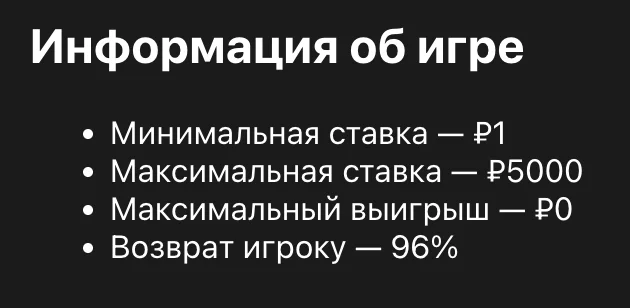
Flappy Rise by Astriona has a certified RTP of 96%, meaning the game returns $0.96 in expected value for every $1.00 wagered over an infinite number of rounds. The house edge of 4% represents Astriona's mathematical advantage over every player across all rounds played.
In practical terms: a player betting $10 per round and playing 100 rounds wagered $1,000 total. At 96% RTP, the expected return is $960 — a statistical expected loss of $40. This is the long-run mathematical outcome, not a guaranteed result for any specific 100-round session. Short sessions can produce outcomes significantly above or below this expectation due to variance.
Flappy Rise's medium-high volatility amplifies short-term variance above what lower-volatility games produce. Medium-high volatility means the distribution of crash multipliers includes more rounds at extreme values (both very low crashes below 1.5x and occasional high multipliers above 10x) compared to a low-volatility game where outcomes cluster near the mean. This variance profile is what makes strategies that cap maximum losses valuable — the expected loss per session from variance can easily exceed the mathematical 4% house edge in short-run play.
Expected Value by Target Multiplier
Regardless of which cash out multiplier target you select in Flappy Rise, the expected value per dollar wagered remains $0.96 across a statistically significant number of rounds. A 1.5x target, 2.0x target, or 10x target all carry the same long-run EV of -$0.04 per $1 bet. The target multiplier affects win frequency and payout size — not the expected value.
| Target Multiplier | Approx. Win Frequency | Payout per $10 Bet | Expected Value |
|---|---|---|---|
| 1.30x | ~73% | $13.00 | -$0.40 / $10 |
| 1.50x | ~63% | $15.00 | -$0.40 / $10 |
| 2.00x | ~47% | $20.00 | -$0.40 / $10 |
| 3.00x | ~31% | $30.00 | -$0.40 / $10 |
| 5.00x | ~19% | $50.00 | -$0.40 / $10 |
| 10.00x | ~9% | $100.00 | -$0.40 / $10 |
Analyst Note: Win frequencies above are approximate estimates based on a 96% RTP crash game distribution. Actual Flappy Rise round outcomes may differ due to provably fair randomness. These figures illustrate the statistical relationship between target multiplier, win rate, and payout — they are not guarantees.
Strategy 1: Conservative Approach — Auto Cash Out 1.3x–1.5x

How the Conservative Strategy Works
The conservative strategy for the flappy bird casino game targets Auto Cash Out values between 1.3x and 1.5x on Panel 1. At a 1.5x target, a round must crash below 1.5x to produce a loss. Based on Flappy Rise's RTP distribution, approximately 37% of rounds crash before reaching 1.5x — meaning 63% of rounds produce a win at this target.
At 1.3x, the win frequency rises to approximately 73%, but each winning round only returns 30% profit on the bet. A $10 bet at Auto Cash Out 1.3x returns $13 on a win, producing $3 profit. The increased win frequency compensates for the reduced profit per round, maintaining consistent session performance.
Conservative Strategy Setup in Flappy Rise
- Open Flappy Rise and navigate to Panel 1
- Set bet amount to your unit size (recommended: 1–2% of total session bankroll)
- Enable Auto Cash Out and enter 1.5 in the target field
- Enable Auto Bet to automate round-by-round bet placement
- Set a session loss limit in advance (recommended: 20 units from your starting balance)
- Stop playing when your balance drops by 20 units or when you've reached your session win target
Conservative Strategy: Pros and Cons
Advantages
- High win frequency (63% of rounds at 1.5x)
- Consistent small profits reduce emotional swings
- Auto Cash Out eliminates timing errors
- Works well with 1Win Casino 30% cashback on losses
- Low minimum bet ($0.10) suits all bankrolls
Disadvantages
- Low profit per winning round ($1.50–$3 per $10 bet)
- Multiple consecutive losses can still occur (37% loss rate)
- Does not capitalize on Flappy Rise's high-multiplier potential
- Long sessions required to build significant profit
Strategy 2: Dual-Bet Hedge — Panel 1 Safety + Panel 2 Hunt
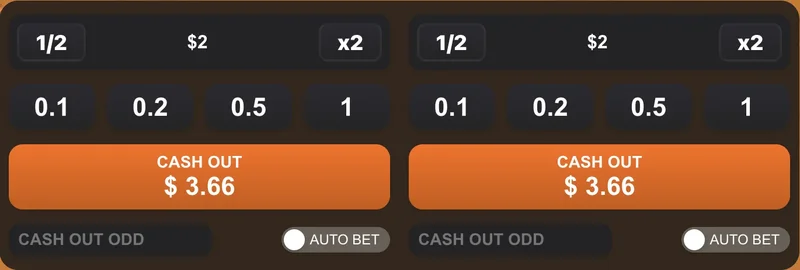
The Mechanics of Dual-Bet Hedging
The dual-bet hedge leverages Flappy Rise's unique two-panel architecture to simultaneously generate consistent small returns on Panel 1 while maintaining exposure to high-multiplier events on Panel 2. No competing crash game in 2026 offers this capability — it is exclusive to Flappy Rise by Astriona.
Panel 1 (the "safety" panel) places a larger bet with Auto Cash Out at 1.5x. Panel 2 (the "hunt" panel) places a smaller bet targeting 5.0x or higher with manual or Auto Cash Out. The mathematical relationship between the two panels is: Panel 1 finances the hunt by generating consistent small wins that offset Panel 2 losses in rounds that crash below 5x.
Dual-Bet Hedge Configuration Example
| Panel 1 Bet | $10 |
|---|---|
| Panel 1 Cash Out Target | 1.5x (Auto Cash Out) |
| Panel 1 Win Amount | $15 (+$5 profit) |
| Panel 2 Bet | $3 |
| Panel 2 Cash Out Target | 5.0x (manual) or 6.0x (Auto) |
| Panel 2 Win Amount at 5x | $15 (+$12 profit) |
| Net on Round Crash at 1.3x (before Panel 1 target) | -$13 total |
| Net on Round Crash at 2.0x (Panel 1 wins, Panel 2 loses) | +$5 - $3 = +$2 net |
| Net on Round at 5.0x (both panels win) | +$5 + $12 = +$17 net |
When the Dual-Bet Hedge Outperforms Single-Panel Play
The dual-bet hedge in Flappy Rise produces better risk-adjusted outcomes than single-panel play in sessions where 40–70% of rounds land between 1.5x and 5.0x. In these rounds, Panel 1 wins while Panel 2 loses — the small Panel 1 profit partially offsets the Panel 2 loss. In rounds that exceed 5.0x, both panels win, generating outsized returns. In rounds below 1.5x, both panels lose, but the total loss ($13 in the example above) is capped by the Panel 2 bet being smaller than Panel 1.
The hedge ratio (Panel 1 bet ÷ Panel 2 bet) determines how conservative or aggressive the overall approach is. A 10:3 ratio ($10 Panel 1, $3 Panel 2) is moderately conservative. A 5:5 ratio is a pure equal split. A 3:10 ratio (small safety, large hunt) is aggressive and suitable only for players with large bankrolls and high risk tolerance.
Strategy 3: Stop-Loss Session Management

The 20-Unit Stop-Loss Rule
Session management is not a betting strategy — it is a discipline framework that wraps around any approach you use in the flappy bird casino game. The core principle: define the maximum loss for any single session before beginning play. Aaron Mitchell recommends 20 units as the stop-loss threshold for Flappy Rise given its medium-high volatility.
A "unit" is your base bet denomination. At $1 per unit, the session bankroll is $50 and the stop-loss triggers at $30 remaining balance ($20 loss). At $5 per unit, the session bankroll is $250 and the stop-loss triggers at $150 remaining. The ratio is what matters — not the absolute dollar amount.
Session Win Target
Equally important is a win target — the profit level at which you stop and bank your winnings. Aaron Mitchell's recommendation: a win target of +30 units from the starting session balance. At $1/unit and $50 start, the win target is $80. When reached, stop playing for the session regardless of recent momentum or "feeling." The win target prevents giving back profits during emotional "riding the wave" play.
Combining Stop-Loss with Cashback Bonuses
The stop-loss framework pairs powerfully with the 1Win Casino 30% weekly cashback offer. If a session ends at the stop-loss trigger (losing 20 units = $20 at $1/unit), 30% cashback returns $6 of that loss, reducing the effective session loss to $14. Over 10 stop-loss sessions, cashback would return approximately $60 — meaningful recovery within the 96% RTP framework.
Bankroll Management for Flappy Rise Players

Bankroll management in the flappy bird casino game Flappy Rise begins with one non-negotiable principle: never gamble money you cannot afford to lose entirely. The 4% house edge in Flappy Rise ensures that the expected long-run outcome for any player is a loss. Bankroll management is about maximizing enjoyment and session longevity within that mathematical reality.
Aaron Mitchell's recommended session bankroll for Flappy Rise is 50x the base bet unit. At $0.50/unit base bet, the recommended session bankroll is $25. At $2/unit, it is $100. This sizing ensures the session bankroll can survive a realistic losing streak (15–20 consecutive low crashes) without being depleted before the session can recover.
The total gambling bankroll — money allocated to all casino play, not just one session — should be sufficient for at least 10 sessions at the recommended session bankroll level. A player playing Flappy Rise at $1/unit with a $50 session bankroll should have a total gambling bankroll of at least $500 before beginning. This prevents any single bad session from forcing emotionally compromised play in subsequent sessions.
Bankroll by Playing Style
| Player Type | Base Bet Unit | Session Bankroll | Total Recommended Bankroll | Recommended Casino |
|---|---|---|---|---|
| Micro Stakes | $0.10 | $5 | $50 | Any of the 7 listed |
| Low Stakes | $0.50 | $25 | $250 | 1Win Casino (cashback) |
| Mid Stakes | $2.00 | $100 | $1,000 | Stake Casino (rakeback) |
| High Stakes | $10.00 | $500 | $5,000 | Stake or 1Win VIP |
Flappy Rise Strategy Myth Busting
Common misconceptions about winning strategies in the flappy bird casino game — debunked with evidence
Myth 1: "After several low crashes, a big multiplier is due"
Reality: Flappy Rise's provably fair algorithm determines each round's crash point independently. Five consecutive crashes below 1.5x do not increase the probability of a high multiplier in round 6. Each round is statistically independent — the "gambler's fallacy" of expecting variance correction is not applicable to provably fair crash games.
Myth 2: "Martingale strategy is effective in Flappy Rise"
Reality: The Martingale strategy (doubling bet after each loss) fails in Flappy Rise for two structural reasons. First, the maximum bet limit of ₽5,000 per panel caps the number of Martingale doublings before hitting the ceiling. Second, Flappy Rise's medium-high volatility produces extended streaks of sub-1.5x crashes that exhaust a Martingale bankroll in a small number of rounds. In testing, a $10 base Martingale bet would require a $10,240 bet on round 10 of a losing streak — exceeding the maximum bet limit.
Myth 3: "Setting Auto Cash Out at exactly 2x guarantees profit"
Reality: At a 2.00x Auto Cash Out, Flappy Rise wins approximately 47% of rounds based on 96% RTP distribution. In 100 rounds at $10 each, expected wins: 47 rounds × $20 = $940. Expected losses: 53 rounds × $10 = $530. Net expected outcome: +$410 from wins minus $530 from losses = -$120 total, equaling roughly the 4% house edge on $1,000 wagered. The 2.00x target does not guarantee profit any more than any other target.
Myth 4: "Playing at certain times of day improves results"
Reality: Flappy Rise's provably fair algorithm operates identically 24 hours a day, 7 days a week. No time of day, no specific casino, and no specific device affects the probability distribution of crash multipliers. The RTP of 96% is constant regardless of when or where you play the flappy bird casino game.
Optimistic Strategy Outlook
Flappy Rise is encouraging for strategy-minded players because its most important controls are simple enough to plan before the first round. The 96% RTP, dual bet panels, auto cash-out targets, 1.3x-1.5x conservative range, 5x+ hunt panel, and stop-loss guidance all give the player a practical framework. That does not remove the 4% house edge, but it does make the game more manageable. A player can test the dual-bet hedge in demo mode, choose a fixed unit size, and decide whether the session goal is longer play or a small allocation toward higher multipliers.
The optimistic version of Flappy Rise strategy is calm repetition. Panel 1 can provide structure through early exits, while Panel 2 adds excitement only when it fits the budget. Pausing after large wins, early-crash streaks, or any urge to increase stakes keeps the strategy from turning emotional. With that discipline, the flappy bird casino game remains a readable, fast, and entertaining crash session rather than a chase.
Strategy FAQ — Flappy Bird Casino Game
No. There is no guaranteed winning strategy for Flappy Rise or any casino game. Each round's crash point is determined by Astriona's provably fair cryptographic algorithm — results are independently random. Strategies on this page are bankroll management frameworks that operate within the game's 96% RTP. They extend session longevity and reduce variance but cannot overcome the 4% mathematical house edge over infinite rounds.
At 96% RTP, no specific cash out multiplier improves expected value above $0.96 per $1 wagered in the long run. Lower target multipliers (1.3x-1.5x) win more frequently and suit conservative bankrolls. Higher targets (5x+) win less frequently but produce larger individual payouts. The best multiplier depends on your risk tolerance, bankroll size, and session goals. The dual-bet hedge on Panel 1 (1.5x auto) and Panel 2 (manual 5x+) offers both approaches simultaneously.
The Martingale strategy is not recommended for Flappy Rise. The game's maximum bet limit of ₽5,000 per panel caps the number of doublings before the strategy becomes mechanically impossible. Flappy Rise's medium-high volatility also produces extended early-crash streaks that can exhaust a Martingale bankroll in 7-10 rounds. A $10 starting Martingale bet would require a $1,280 bet on round 8 of a losing streak — feasible but risky. By round 10 it requires $10,240, exceeding the maximum bet limit.
The dual bet hedge uses Flappy Rise's two independent panels to place a large safety bet on Panel 1 (Auto Cash Out at 1.5x) and a smaller hunt bet on Panel 2 (targeting 5x+). Panel 1 wins approximately 63% of rounds, generating small consistent profits. Panel 2 wins less frequently but produces larger payouts. In rounds where both panels win (round exceeds 5x), overall session profit is maximized. In rounds where Panel 1 wins and Panel 2 loses (crash between 1.5x and 5x), the net position is positive. Only rounds crashing below 1.5x produce net negative outcomes.
Aaron Mitchell recommends a minimum session bankroll of 50x your base bet unit for Flappy Rise. At $1 base bet, a $50 session bankroll allows enough rounds to experience statistical variance without early session-ending losing streaks. The total gambling bankroll (for all sessions) should be at least 10x the session bankroll — $500 for a $1/unit player. Never play with money needed for essential expenses.
Your Learning Path
Five steps to confident play — your current position is highlighted. Follow the sequence, or jump to the step that's most useful right now.